
Crypto's Equity Perpetual Futures- 2026 most understudied opportunity in crypto
Equity perpetual futures are coming to crypto in a big way, join now or regret later

This is one of my crypto investment theses for 2026, I hope it stimulate your thinking and possibly lead to action,
tl;dv
Pioneered in crypto by BitMEX (2016) with BTC perps.
Early perps focused on cryptocurrencies, indices, commodities, forex. High leverage (50x–100x+), 24/7 trading, no delivery.
Equity perps (launched ~2020–2022 on platforms like BitMEX, Bybit, kraken etc) extend this to individual stocks (e.g., TSLA, NVDA) via synthetic/tokenized exposure.
Key DifferencesAsset class: Crypto-native → bridging TradFi (stocks, even when markets closed).
Use case: Equity volatility from earnings, macro events vs. crypto-specific catalysts.
Accessibility: 24/7 global trading, crypto collateral (USDT/USDC), high leverage.
Risks: Liquidation, funding rate swings amplified by stock news.
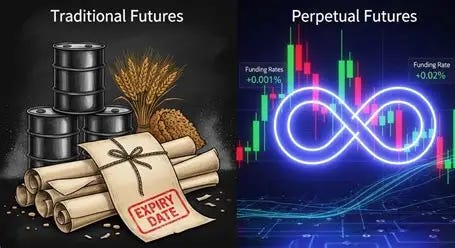
The concept this year has been equity in crypto but only a few are talking about the more lucrative opportunity, Equity Perpetual Futures. Based on my research I just want to draw your attention to one of my most treasured thesis for 2026, either to participate in the market or make money from the funding rate. At the end of this article, I have listed a couple of perps you should look into.
Perpetual futures often called “perps,” are derivative contracts that allow traders to speculate on an asset’s price without an expiration date, using mechanisms like funding rates to keep the contract price aligned with the underlying spot price. Unlike traditional futures contracts, which have a fixed expiration date, perpetual futures can be held indefinitely as long as the trader maintains the required margin. The concept in crypto was first proposed by economist Robert Shiller in 1992 as a way to create derivatives for illiquid assets like real estate or human capital.
However, perps gained practical traction in the cryptocurrency space, where they were pioneered by the exchange BitMEX in 2016 with Bitcoin perpetual futures (e.g., BTC/USD perps).
This innovation addressed limitations in traditional futures, which have fixed expiry dates and require rollover to maintain positions, often leading to gaps in trading or additional costs.Early perps in crypto were primarily focused on cryptocurrencies themselves (e.g., BTC, ETH) and later expanded to include indices, commodities, and forex pairs. These allowed for high leverage (up to 100x or more), 24/7 trading, and no need for physical delivery, making them popular for hedging and speculation in volatile markets.
Funding rates—periodic payments between long and short positions—ensure the perp price doesn’t drift too far from the spot, replacing the convergence mechanism of expiring futures. Equity perps represent a more recent evolution, extending this model to individual stocks or tokenized equities. They enable synthetic exposure to stock prices (e.g., TSLA or NVDA) without owning the shares, often settled in stablecoins like USDT and USDC.
Key differences from prior crypto perps include:
Asset Focus: Previous perps were crypto-native or broad-market (e.g., BTC perps for miners’ hedging), while equity perps bridge traditional finance by allowing 24/7 trading on stocks, even when stock exchanges are closed (e.g., weekends or holidays).
Accessibility and Leverage: They offer similar high leverage but target equity volatility, which can be influenced by corporate earnings, economic data, or sector trends, rather than just crypto-specific events like halvings.
Tokenization: Often involve synthetic or tokenized versions of stocks, enabling global access without regulatory hurdles of direct stock ownership in some jurisdictions.
Market Integration: Equity perps add liquidity to tokenized equities, which were previously limited to spot trading on crypto platforms.
tdsecurities.com
This shift has blurred lines between crypto and traditional markets, but it introduces risks like higher volatility from leverage and funding rate fluctuations.
Please consider supporting us at Cryptofada Newsletter
With just $2 weekly, you will support the newsletter and access 100% of the Defi/Crypto opportunities we share at least twice weekly:
What to expect:
👉 Every Monday: Ecosystem/Mainnet/funding updates, Defi Yield farming, Staking Airdrops, Research/reports, ICO/IDO/Presales and Crypto Jobs and trading opportunities
👉 Every Thursday: Protocol Spotlights, with in-depth analysis of 2-5 select protocols or tokens, and yield farm opportunities.
N/B:
Free Subscribers: Have access to 20% of the content as an overview
Paid Subscribers: Have access to 100% of the contents and community features like chat room (10x alphas are shared on the chat room) etc
Potentially Profitable Equity Perps in the near future depends on volatility (for short-term trades), directional trends (e.g., bull runs in AI or renewables), and leverage use—long positions benefit from upside, shorts from downside. Based on current market analyses for 2026, which highlight themes like AI growth, renewable energy transitions, and small/mid-cap recoveries amid expected market volatility (e.g., S&P 500 potentially rallying 20% but with twists from elections), here are some equity perps that could be highly profitable if trends hold.
NVIDIA (NVDA): AI chip dominance continues into 2026, with high volatility from earnings and tech demand. Past performance (e.g., +1,326% in prior years) suggests strong upside potential in a rallying market.
Profitable for longs if AI hype persists; expect swings from competition.
Tesla (TSLA): EV and autonomous driving sectors are volatile but promising, with renewable energy ties. Mid-term election uncertainties could boost green stocks, making TSLA perps ideal for leveraged bets on policy shifts.
Vertiv Holdings (VRT): Data center infrastructure for AI, seen as an “AI winner” with recent volatility offering entry points. Could deliver huge gains as tech expands.
GE Vernova (GEV): Spun-off energy arm focusing on renewables; high volatility in energy futures aligns with stock moves, profitable if global green transitions accelerate.
Innodata (INOD): AI data processing small cap with extreme volatility (top US volatile stock in Jan 2026). Suited for short-term perps trades, potentially very rewarding in AI booms but risky.
AMD (Advanced Micro Devices): Direct competitor in AI chips/GPUs. High volatility from market share battles with NVDA; often sees sharp moves on earnings or AI demand news. Strong candidate for longs in continued tech bull runs or shorts on pullbacks.
Super Micro Computer (SMCI): AI server hardware leader. Extremely volatile (frequent 10-20%+ daily swings tied to AI supply chain). Popular for momentum trades in perps, especially if data center buildout accelerates.
Palantir Technologies (PLTR): AI/software analytics play with government and enterprise contracts. Known for meme-like volatility and retail interest; profitable in hype cycles or corrections.
GitLab (GTLB): DevOps/AI-integrated platform, highlighted in recent analyses as a beaten-down stock poised for rebound in January 2026. Lower-cap volatility makes it suitable for leveraged perps plays on AI dev tools growth.
nCino (NCNO): Cloud banking software with AI features. Another “January effect” candidate after underperformance; potential for sharp upside if fintech/AI adoption picks up.
Samsara (IOT): IoT/AI fleet management. Volatile small/mid-cap with rebound potential in industrial tech; good for perps if logistics or automation themes strengthen.
Global-e Online (GLBE): E-commerce platform with cross-border focus. Beaten-down name expected to recover in 2026; volatility from retail/e-comm cycles suits short-term perps trading.
Harrow Health (HROW): Top volatile US stock in early 2026 lists (small-cap pharma/health). Extreme price swings make it high-reward (and high-risk) for perps, especially on news catalysts.
Coinbase (COIN): Crypto exchange stock, but trades as equity perp. Highly correlated to BTC/ETH moves + regulatory news; often one of the most active equity perps due to crypto-native traders.
MicroStrategy (MSTR): Bitcoin treasury play. Massive volatility from BTC correlation; one of the most traded equity-linked perps proxies in crypto ecosystems.
DEX platforms one can trade the equity perps
Here are some DEX (decentralized exchange) platforms where users can trade equity perpetual futures (or synthetic/stock perps, often providing 24/7 leveraged exposure to individual US stocks, indices, or tokenized equities using crypto collateral like USDC/USDT). These are onchain or hybrid-DeFi platforms, distinct from centralized ones like BitMEX, Bybit, or Binance.
As of January 2026, the space is evolving rapidly with a focus on RWA (real-world asset) perps, tokenized equities, and high-leverage derivatives bridging TradFi and crypto. Availability, specific equity pairs (e.g., NVDA, TSLA, or indices like S&P 500), leverage levels (often 20x–100x+), and regional access can vary—always connect via a compatible wallet (e.g., MetaMask), check current listings, funding rates, and liquidity on the platform, and be aware of smart contract risks. Key DEX platforms offering equity/stock perps:
Aster: A next-generation decentralized perpetual exchange that launched 24/7 stock perpetual contracts in 2025, providing exposure to US equities and indices. It supports MEV-free trading, one-click execution, and high leverage (up to 100x in some cases). Popular for bridging crypto-native trading to traditional stocks onchain.
Lighter: A dominant onchain perps exchange that rolled out 24/5 (and expanding) equity perps trading in early 2026. It focuses on high-performance perpetuals with crypto collateral, including synthetic exposure to stocks and TradFi assets. Known for strong liquidity and growing dominance in onchain derivatives.
Ostium: Specializes in RWA perps, allowing trading of synthetic versions of stocks, commodities, forex, and equities. It’s one of the go-to platforms for non-crypto asset perpetuals in DeFi, with flexible leverage and onchain settlement.
Avantis (on Base network): A decentralized perpetuals and synthetic assets platform offering exposure to both crypto and real-world assets, including equity-linked perps. It provides leveraged trading on tokenized or synthetic stocks/indices.
Pacifica: A flexible DEX emphasizing perpetual futures on RWAs, including equities. It stands out for adaptable trading mechanics and support for stock/index perps in a decentralized setup.
MetaMask Perps: Integrated directly into MetaMask (mobile and extension), this allows decentralized perpetual futures trading with up to 40x leverage on various assets, including cross-chain support for synthetic or equity exposures (no KYC in permitted regions). It’s user-friendly for wallet-native trading.
Hyperliquid: Leading onchain perps platform with massive volume; while mainly crypto, it influences the space and has indirect ties via ecosystem tools for broader asset perps.
Reya Network: High-performance L2-based perp DEX, often highlighted for 2026 growth and potential TradFi integrations.
Extended (on Starknet): Hybrid perp DEX offering USDC-settled perps on crypto and selected TradFi/equity markets with high leverage.
Trade with caution—high leverage amplifies both gains and liquidation risks. This is not financial advice.
The VRT mention caught my attention bc most analysis overlook how data center plays scale differently than chip makers. Had a conversation with someone running infra for a mid-size AI firm—they said cooling and power distribution constraints are becomming the real bottleneck, not compute. The perps angle makes sense here since infrastructure capex cycles move slower but more predictably than semiconductor hype cycles.